
45Z Transfer Pricing in 1H 2026: What’s Actually Moving the Bid
The first half of 2026 marks the transition of Section 45Z clean fuel production tax credits from an emerging concept to an execution-driven market. After a slow and uncertain 2025, pricing is now less about headline credit value and more about how transactions are structured, documented, and delivered.
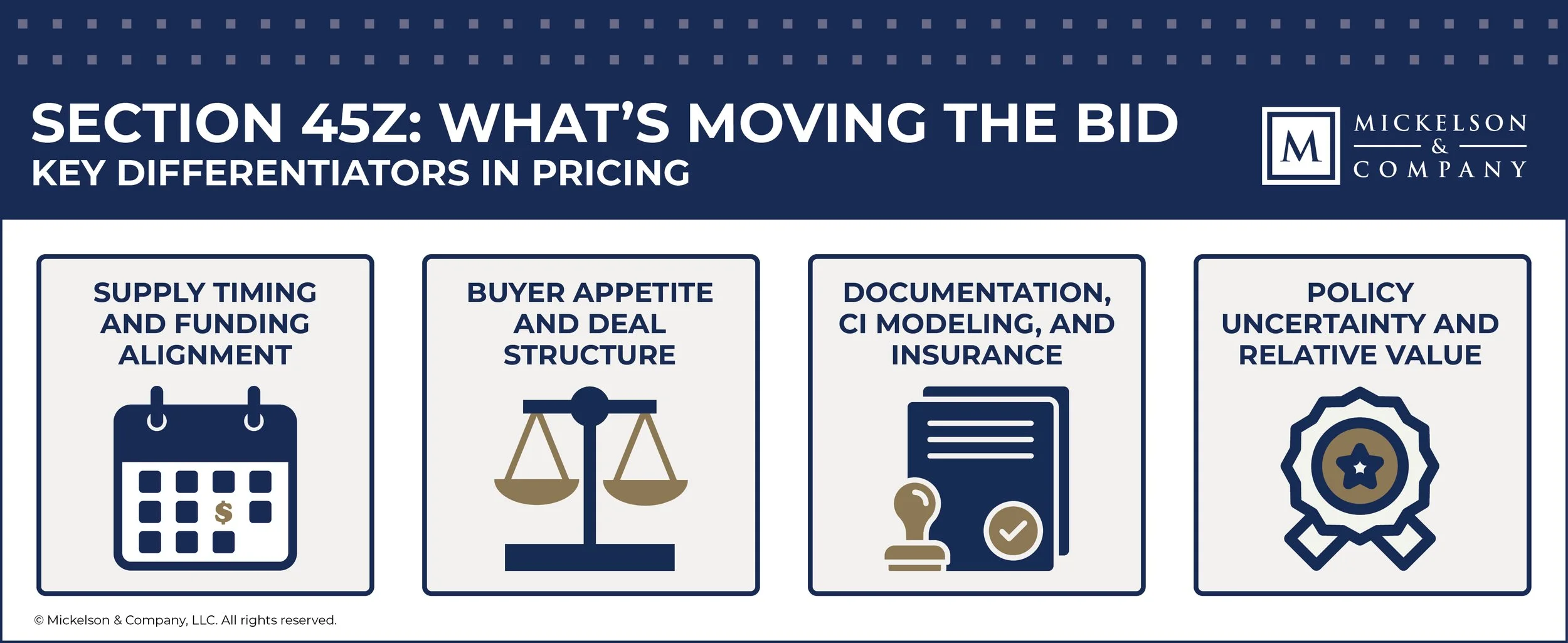
Supply timing, buyer tax appetite, documentation quality, and a policy uncertainty discount are driving outcomes. At the same time, deal structure — particularly funding timelines, contract duration, and insurance — has become a key differentiator in pricing.
2025 Baseline: Early Market Formation
In 2025, the transferable tax credit market experienced modest price compression, with most production tax credits trading in the low- to mid-90 cents per dollar range.
For §45Z, the market remained in the early stage and was characterized by:
Limited transaction volume and reliance on one-off negotiated deals
Use of contracts for future credit delivery
Pricing based on comparable credits rather than underlying fuel economics
As a result, pricing reflected uncertainty discounts, driven by evolving guidance and limited operational history.
What’s Driving Pricing in 1H 2026
#1: Supply Timing and Funding Alignment
With 2026 as the first full compliance year, supply has increased but buyer demand has been uneven.
Corporate taxpayers have focused on closing out 2025 tax positions as their provisions become firmer. The market will shift focus towards 2026 credit opportunities beginning in Q2. As a result, pricing is increasingly tied to alignment with estimated tax payments, particularly in Q3 and Q4.
Funding timelines are also impacting pricing. Delayed funding typically leads to higher pricing to compensate sellers, while faster execution results in tighter spreads.
#2: Buyer Appetite and Deal Structure
Corporate tax capacity remains the primary constraint, but buyers are becoming more selective.
The market has split between:
High-quality credits clearing near broader benchmarks
More complex credits trading at modest discounts
Sellers offering multi-year commitments can access deeper buyer pools but typically accept slightly lower pricing in exchange for certainty.
#3: Documentation, CI Modeling, and Insurance
Documentation has become a core pricing driver. Buyers are focused on:
Carbon intensity (CI) modeling and scoring
Production and sales reports
Compliance with Prevailing Wage & Apprenticeship (PWA) and other requirements
Credits with strong, audit-ready support command better pricing and faster execution.
At the same time, insurance is emerging as a differentiator. Insured credits can achieve pricing premiums by reducing downside risk and simplifying diligence.
#4: Policy Uncertainty and Relative Value
Section 45Z continues to carry policy uncertainty tied to evolving rules and CI modeling assumptions. Buyers account for:
IRS challenge risk
Potential credit disallowance or adjustment
Ongoing interpretive uncertainty
This creates a policy uncertainty discount, keeping §45Z priced below more established credits.
However, this discount is increasingly viewed as a relative value opportunity. Compared to credits like §45X, §45Y, or traditional Section §45 PTCs, §45Z can often be acquired at a lower price despite similar underlying tax capacity characteristics. As underwriting improves, the gap between perceived risk and pricing is narrowing.
Where Pricing Stands
Three themes define the 1H 2026 market:
Greater price dispersion based on timing, structure, and risk
Clear stratification between high-quality and more complex credits
Structural pricing adjustments, including:
Delayed funding > higher pricing
Multi-year commitments > lower pricing
Insurance > modest premium
Overall pricing is slightly softer than 2025, but far more dependent on execution.
The Bottom Line
The §45Z market has moved from early-stage price discovery to execution-driven pricing. Outcomes are now determined less by the credit itself and more by how it is structured, documented, and delivered.
Supply timing, buyer capacity, and policy clarity remain foundational. Increasingly, funding certainty, contract duration, and risk mitigation tools like insurance are what separate premium trades from discounted ones.
At the same time, the policy uncertainty discount is attracting more disciplined buyers who see relative value in the asset class. As buyers develop clearer investment theses, §45Z is increasingly being evaluated not just as a discounted credit but as a potentially mispriced one.
For more information, reach out to Vice President Nick Scott at nick@mickco.com or 605-977-4873 ext. 5, or one of our team members if you are interested in learning more about tax credit transfers.
Your organization should seek independent legal, tax, and accounting advice as part of this process. Mickelson & Company is not providing legal or accounting services.