
Industrial Development Tax Credits: Supporting Economic Growth While Generating State Tax Savings

States are constantly looking for innovative ways to compete for new private investment. One tool that is gaining popularity is the Industrial Development Tax Credit, a transferable tax credit that allows taxpayers to reduce their state tax liability while also supporting meaningful economic development projects across rural America.
A Vital Link to National Markets
Industrial Development Tax Credit programs are currently available in several states, including Indiana, Mississippi, Oklahoma, West Virginia, and Wisconsin. These credits are earned through new short line railroad construction projects like rail spurs, sidings, and other necessary infrastructure. Short line railroads play a vital role in the hub-and-spoke transportation network, often providing the first and last mile service for a longer journey. In many communities, short line railroads are the only way customers can connect to the national network, allowing them to keep their business and employees local.
Large industrial projects often require substantial infrastructure investments before a facility can begin operations. States recognized that a tax incentive could bridge the funding gap and attract privately funded projects that deliver long-term tax revenue. In many cases, the result is a project that creates steady economic activity for decades.
How the Credit Works
Consider a hypothetical example: A company plans to construct a new grain processing facility in a rural community. To make the project viable, it must build a rail connection to a nearby short line railroad. The infrastructure costs several million dollars. An Industrial Development Tax Credit helps offset a portion of those costs, allowing the project to move forward. The result is new jobs, increased freight traffic, additional local investment, and expanded economic activity throughout the region.
Program Mechanics and Unique State Incentives
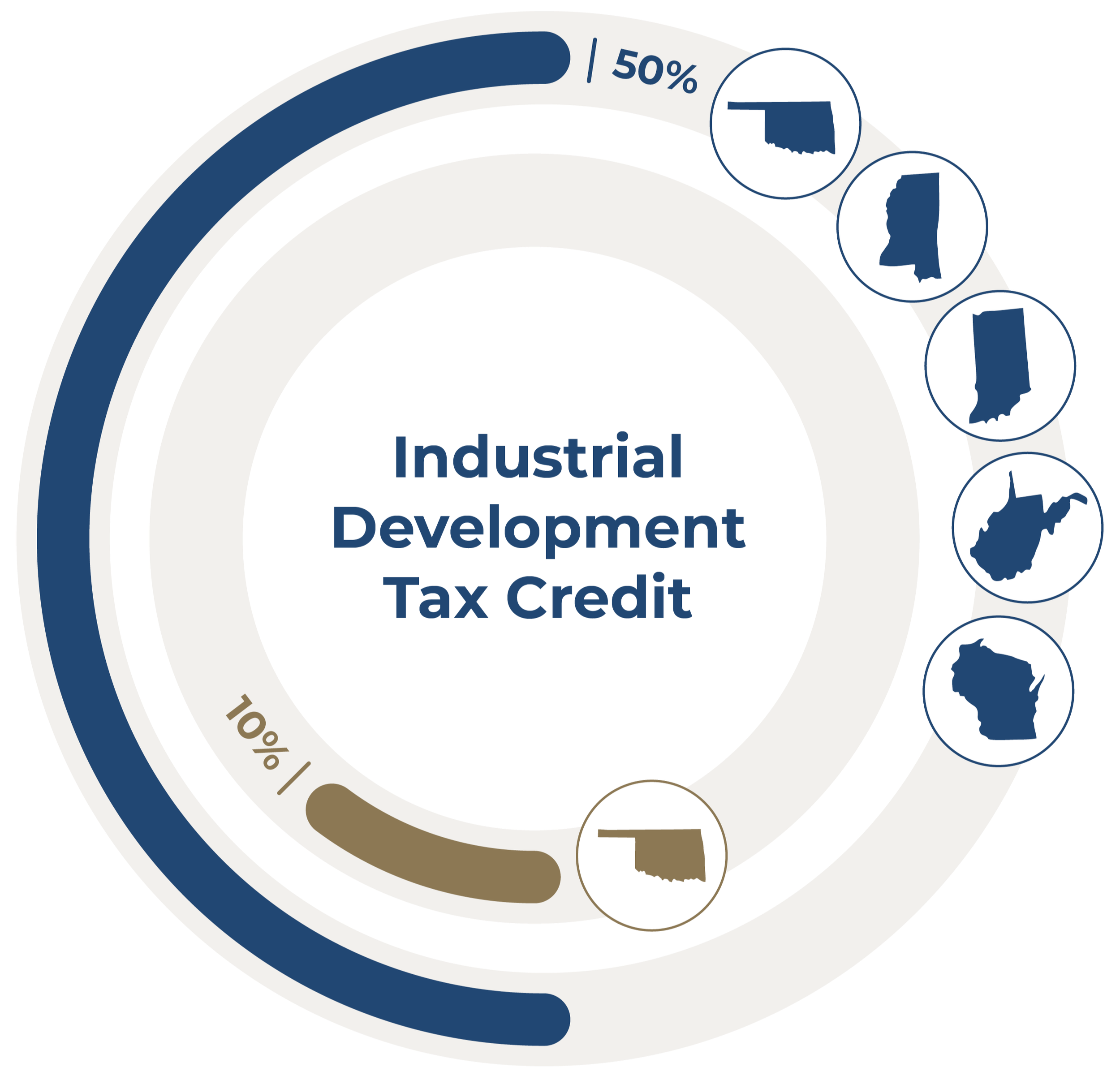
While there is some variation from state to state, these credits are generally structured as a 50% tax credit for qualified expenditures with an annual statewide cap ranging from $5 million to $12 million per year. Additionally, in Oklahoma, companies locating or expanding in rural areas may also qualify for an additional 10% tax credit, creating even greater support for investment.
Key Benefits for Tax Credit Buyers
Unlike many tax incentives that can only be used by the original project sponsor, Industrial Development Tax Credits are transferable, creating opportunities for taxpayers with state tax liabilities to acquire credits and realize immediate tax savings.
For tax credit buyers, Industrial Development Tax Credits offer a couple characteristics that distinguish them from other state tax incentives.
First, these credits are tied to tangible infrastructure assets that support real economic development projects. Buyers can appreciate the direct connection between the credit and the underlying investment.
Second, the market for Industrial Development Tax Credits is generally less crowded than some of the more established tax credit sectors. This can create opportunities for buyers seeking diversification within their state tax planning strategies.
At Mickelson & Company, we connect investors and corporations with high-quality tax credit opportunities, delivering both financial performance and community impact. Our team brings deep expertise in infrastructure and tax credit policy, guiding tax credit buyers through each step, from initial evaluation and due diligence to transfer execution and compliance.
For more information, reach out to our Industrial Devlopment Tax Credit experts:
Ryan Pidde, ryan@mickco.com or 605-977-4873 ext. 2.
Justin Bentaas, justin@mickco.com or 605-977-4873 ext. 6.
Cate Davis, cate@mickco.com or 605-977-4873 ext. 6.
Your organization should seek independent legal, tax, and accounting advice as part of this process. Mickelson & Company is not providing legal or accounting services.