
Webinar: Risk Mitigation Strategies for Tax Credit Direct Transfers
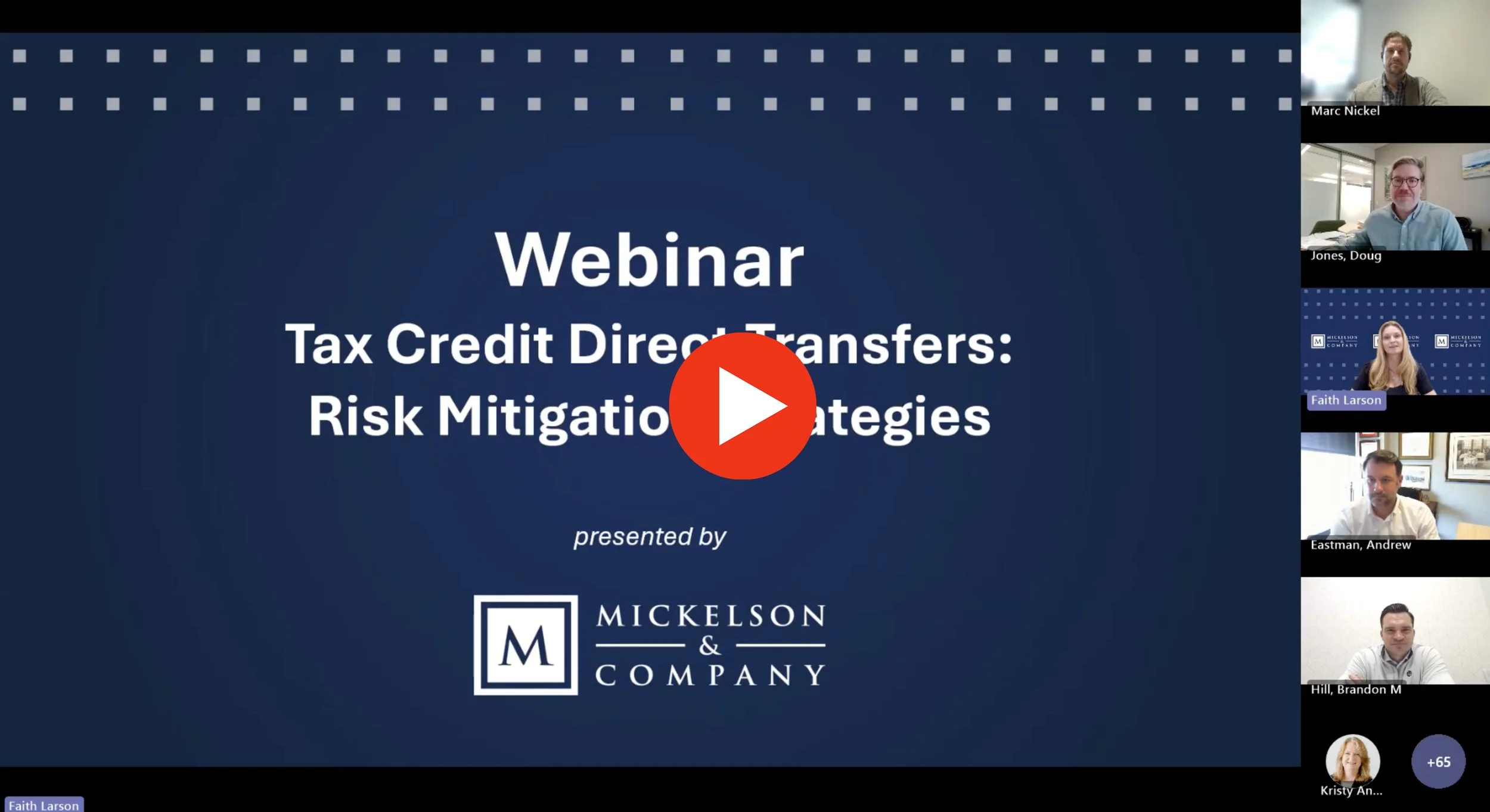
Click on the image above to view the webinar.
As the landscape for renewable energy financing continues to evolve, a sharper focus is being placed on the mechanics of the transferable tax credit market. On March 25, 2026, a panel of industry experts convened for a webinar titled "Tax Credit Direct Transfers Risk Mitigation Strategies" to discuss the opportunities and inherent risks for buyers and sellers in this burgeoning sector.
Hosted by Faith Larson, Vice President of Renewables and Legal Counsel for Mickelson & Company, the session provided a deep dive into the transferability of credits—a mechanism that has become a cornerstone for funding clean energy projects. Larson was joined by Brandon Hill of CliftonLarsonAllen, Marc Nickel of Aon’s M&A Transaction Solutions Group, and Andrew Eastman and Doug Jones, both partners at Husch Blackwell.
Understanding the Two "Buckets" of Credits
Faith Larson opened the discussion by clarifying the two primary categories of renewable energy transferable tax credits: Investment Tax Credits (ITC) and Production Tax Credits (PTC).
Investment Tax Credits: These are typically one-time transactions based on a percentage of the total investment in the project.
Production Tax Credits: These are based on the actual production of a project over time, providing a recurring stream of credits.
Buyer Strategies
Brandon Hill, a tax principal who leads the Energy Services team at CLA, provided a deep dive into the practical application of these credits following the One Big Beautiful Bill Act (OBBBA). Drawing on his experience leading tax credit transactions, Hill emphasized that the market for transferable credits remains a powerful cash strategy for both developers and corporate investors.
Hill focused on three primary categories of risk mitigation for corporate buyers:
Recapture or structure risk
Excessive credit transfer or basis risk
Eligibility and qualification risk
These function as the primary tools to manage downside exposure and preserve credit value.
Hill also highlighted the rising importance of Prevailing Wage and Apprenticeship (PWA) requirements. He noted that these are now "make-or-break" issues; failure to document compliance can lead to significant credit reductions and penalties, even if the project is otherwise successful.
Seller Strategies
Andrew Eastman and Doug Jones, who co-lead Husch Blackwell’s energy tax credit practice, covered seller strategies to both mitigate risk and protect the validity and amount of the tax credit. The wide range of topics included everything from due diligence to audit defense documentation.
Eastman, who serves on the Renewable Natural Gas (RNG) Coalition renewable fuels advisory board, covered the various protections afforded in the tax credit transfer agreement and other key documents such as the tax credit insurance policy. Jones, a recognized expert in complex tax structures, covered the protections for sellers.
Bridging the Gap with Tax Insurance
A critical component of these transactions is the role of specialized insurance, discussed at length by Marc Nickel, Senior Vice President with Aon’s M&A Transaction Solutions Group.
Nickel explained that while credits are attractive because they are sold at a discount, the fear of IRS recapture or project disqualification often creates a "risk gap" that must be addressed. To bridge this, he helps structure insurance policies that act as a definitive backstop for the purchaser. These products are sophisticated, often covering not just the credit value itself, but also the potential interest and penalties that would be owed to the IRS in a worst-case scenario. By mitigating these "binary risks," Nickel’s team enables more corporate buyers to enter the renewable market with the same confidence they would have in a standard M&A transaction.
Looking Ahead
The webinar underscored that while the market for transferable tax credits offers a streamlined path to project funding and an effective and efficient tax strategy for corporate buyers, these risk mitigation strategies must be considered to reduce the overall risk in the transaction.
As the industry moves forward into 2026, the collaboration between tax advisors, legal counsel, and insurance brokers will be paramount in sustaining the momentum of the renewable energy transition.
About Our Presenters
Faith Larson manages renewable energy tax credits and provides legal counsel at Mickelson & Company. In 2023, Faith joined Mickelson & Company as Vice President of Renewables and Legal Counsel. Faith is an accomplished leader known for driving strategic growth. Before joining Mickelson & Company, Faith served much of her career as an executive in the transportation and agricultural industries, having worked as the Vice President of Corporate Development, Real Estate, and Procurement at CH Robinson Worldwide and as the CFO at GrainBridge.
Brandon Hill is a Tax Principal within CliftonLarsonAllen’s Federal Tax Strategies and leads CLA’s Energy Services team. He provides specialized tax services for clients across a wide range of industries, including energy developers and investors, manufacturing, logistics, and financial institutions. Brandon brings over 16 years of public accounting and renewable energy industry experience in the areas of renewable energy tax credits, tax equity transactions, cross border mergers and acquisitions, and tax planning strategies.
Marc Nickel is a Senior Vice President within Aon’s M&A and Transaction Solutions group. In this role, he is responsible for structuring, brokering and marketing the tax insurance products with a particular focus on energy tax credit monetization transactions. Marc’s expertise includes a broad range of tax controversy and energy issues related to U.S. federal, state, and local taxes. Prior to joining Aon in April 2024, Marc spent more than nearly two decades as a practicing tax attorney at multiple large law firms and in tax counsel roles with public companies in the energy sector.
Andrew Eastman is a partner at Husch Blackwell, where he co-leads the firm’s energy tax credit practice. An accomplished corporate attorney with extensive litigation experience, Andrew represents clients with a dual emphasis on commercial success and risk mitigation. He previously served as general counsel to a national developer of renewable natural gas (RNG) and related projects, overseeing that company’s transactional, commercial, and litigation matters. Prior to that role, Andrew represented institutional defendants in complex civil litigation. He is a member of the RNG Coalition’s renewable fuels advisory board, tax committee, and legal committee.
Doug Jones is a partner at Husch Blackwell, where he counsels businesses on complex tax structures and assists renewable energy developers in generating, maximizing, and transacting tax credits. A co-lead of the firm’s energy tax credit practice, he routinely advises developers of wind, solar, and RNG projects on tax credits, primarily under the Inflation Reduction Act (IRA). He is a member of the tax sections of the American Bar Association, the State Bar of Texas, and the Austin Bar Association.
For more information, please contact our presenters:
Faith Larson: faith@mickco.com
Brandon Hill: brandon.m.hill@claconnect.com
Marc Nickel: marc.nickel@aon.com
Andrew Eastman: andrew.eastman@huschblackwell.com
Doug Jones: doug.jones@huschblackwell.com
Your organization should seek independent legal, tax, and accounting advice as part of this process. Mickelson & Company is not providing legal or accounting services.